
The Unbehaving World

featured photo | Tasha Marie
If you can get a handle on it, it’s probably a door.
I’m wary of doors.
And doorways.
Doors are anticipated architectural technologies. They grant access, they permit exits. What’s critical to note about doors is that they maintain the logic of the architectural frame. A building does not lose its integrity with the inclusion of a door. Doors are systemic agents granting mobility within familiar fields. As such, like the solutions we often offer to our most persistent civilizational challenges, doors allow us to shuffle within the already-known, to move the pieces around in the name of innovation, while maintaining the design.
Doors “behave.”
You know what doesn’t “behave”? Cracks. Architects don’t design cracks, don’t anticipate cracks. Cracks are not part of the furniture; they are the excessiveness of the frame. Design’s ecstasy. They are neither external nor internal. Cracks are not “solutions,” not guarantees or final answers. But something about them marks deterritorializing tensions, and obliquely traces out new realities.
***
I find the presupposition that “artificial intelligences” are “artificial”—namely, the idea that humans have “natural intelligence”—to be more consequential, more interesting, than any of the many forecasts of an impending AI totalitarian takeover.
There’s a subtle ontological move crystallized in the attribution of “artificiality”: a subtlety that works as an apartheid system, which is now playing out in anxious efforts to reassert our dominance and exclusivity. “Well, AI can mimic us, but it can’t really do poetry.” “ChatGPT can do essays, but it isn’t wise.” “Oh no, the livelihoods of artists and animators are threatened by the emergence of AI.”
At some level, the panic is justified: deepfakes, quasi-sentient bots, and artistic algorithms effectively trouble “our” vaunted place in the scheme of things. It’s difficult to know what to do here, to know what to do with artificiality. Perhaps one thing to do is to trouble the assumption of distance between the artificial and the natural.
Maybe nature is unnatural. Maybe nature is artificial. Maybe artifice has a hidden life, the kind that the legendary animators of the Toy Story series transcribed to our delight . . . the kind theologians of panentheistic persuasions wax poetic about. Maybe this is an instance of excess, where something decidedly modern spills beyond itself, becomes fugitive, and calls into question the corporeal forms we’ve adopted.
Maybe we are all AI. And maybe we are not. All at once. Maybe we are all together a part of the frothing foliage of emergence that does not allocate intelligence in a fixed manner.
The earth is not a stable thing, a principled location locked into the subservience of playing backstage to human mobility. Instead, the earth is moving. And “it” is moving so irreverently that one might say the planet is becoming fugitive. That’s why the cracks are showing up everywhere: cracks in settlement; cracks in neurotypicality; cracks in human exclusivity; cracks in democracy and the legitimacy of the nation-state; cracks in time; cracks in being.
I am convinced—in the creaturely ways that conviction marks a gesturing towards and a yearning in risky directions—that this loss of stability, this ontofugitivity of things, traces out a geophilosophy that invites a reconsideration of the premises that have conditioned experience, articulated civilizational problems, and instigated resolutions.
Cracks become matters of ontogenesis, intercessory sites of what is to come and what is not quite done-with. We need a geophilosophy that cultivates ways of following cracks to where they might lead.
***
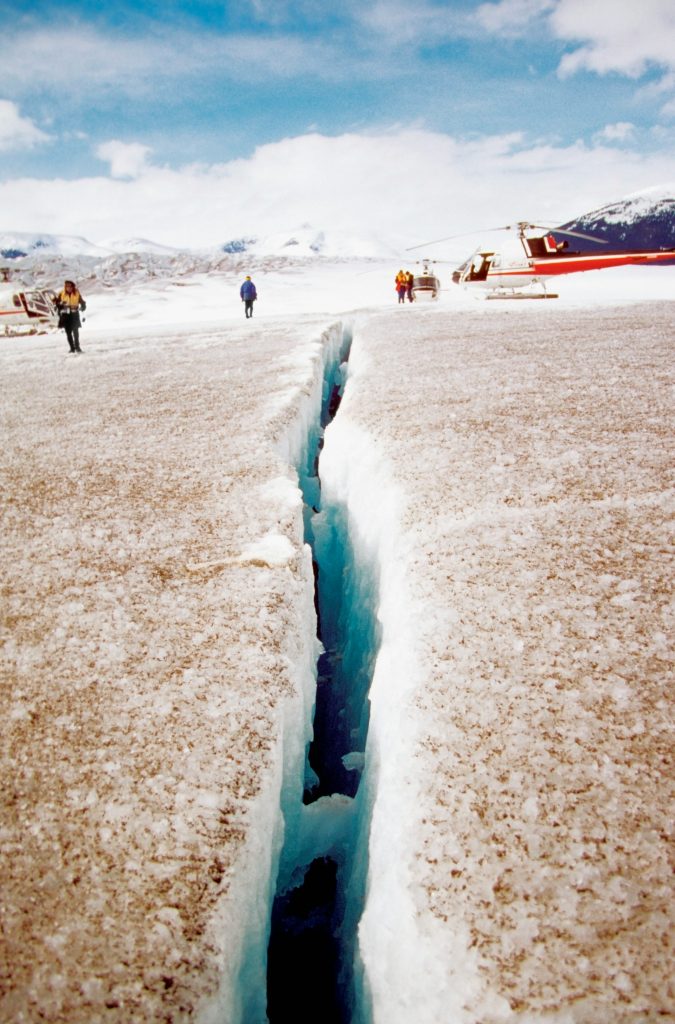
A crack is a rift in the fabric of spacetime, a sacred moment. It is sacred because it hints at the ongoing mobility of “all” things, and suggests that our image of the world, our images of white modernity, of capitalism, of slavery, of justice, of the future, of anything at all, are not static representations of something “objectively” true, but relationships of placemaking and worlding that have risks.
What this means is that what we, for instance, name and lionize as “modernity” doesn’t refer to a fixed reality outside our sensemaking practices. Modernity is made up in part by our social analytics, by instigations in the environment, by things we are doing and things the world is doing to us. Modernity is a relationship, a social production. When we critique it, we are pointing out the ways our analysis of the world discloses to us the inadequacies of a social arrangement, how it for instance uses black and brown bodies as props, how it enlists white bodies as avatars of purity and ascension, how it doesn’t grant us all stable grounds to stand upon. However, we can very often get stuck in images: by treating modernity as a thing to be dismantled, dismissed, destroyed, we become so affixed to its “thingness” that we lose sight of how we are participating within “it,” how even critique is a form of worldmaking that has preservative qualities. Images are never still. Indeed, by focusing on a thing as an image (in this instance, modernity), we obscure the ways “it” is changing, becoming different, never quite static, often beside itself, desirous of something else.
And this is what thinking along with cracks (going into cracks) allows us to do: to cultivate an aliveness and animacy that allow us to follow those delicate moments of spillage, when—to keep up with our example—modernity doesn’t quite behave like itself. When modernity “fails” to keep up with itself.
None of us have it down; none of us can hold it together. We are the frothing, feathery edges of an explosion that is still fanning out into its own creases.

Selah is the second title from Aora Books, a new publishing imprint dedicated to exploring transformational thought and culture that transcends borders, disciplines, and traditions. Rooted in an ethos of polyvocality and planetary consciousness, Aora publishes works that forge bold connections across time, place, ideas, and beings often seen as separate. Preorder the book here.
Publication date: February 24th, 2026
122 pages | Paperback | 5 1/16 x 7 3/4 in. | ISBN: 9781961814318 | e-ISBN: 9781961814356
Book design by Melissa Weiss
Return to the Table of Contents for Remembering the Future